
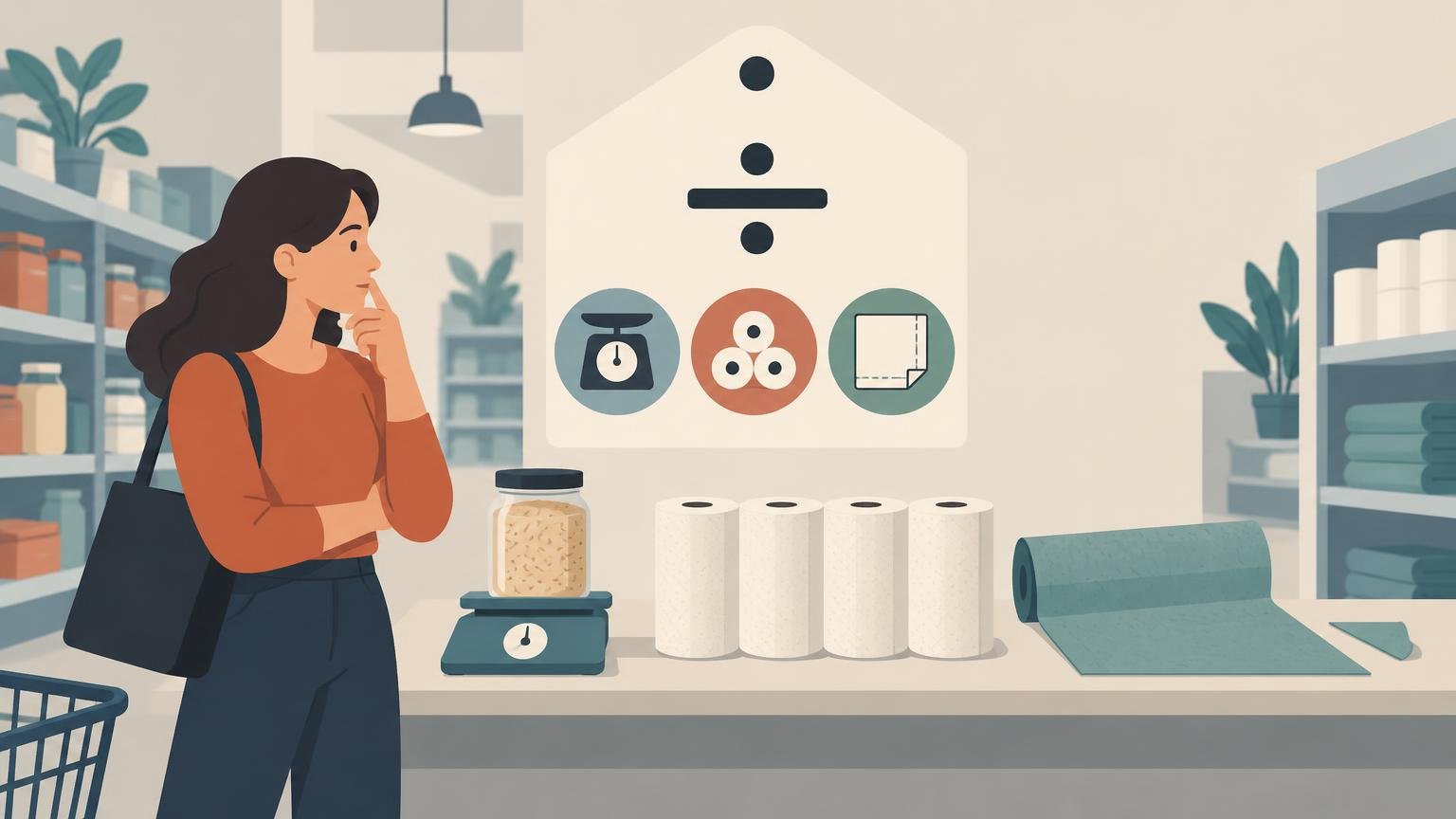
Price per Ounce, Count, or Square Foot: Choosing the Right Unit for Consumer Comparisons
TLDR
For a valid unit price comparison ounce count square foot measures must first be converted to the same physical unit and denominator. Compare ounces with ounces, fluid ounces with fluid ounces, equivalent items with equivalent items, and square feet with square feet. Then make a second comparison for usable quantity, dimensions, concentration, durability, likely waste, and purchase conditions. The lowest displayed unit price identifies the cheapest declared quantity; it does not automatically identify the best product or the lowest cost for what you will actually use.
The core calculation is simple: unit price equals purchase price divided by quantity. The difficult part is choosing a denominator that represents the same thing across products. A 12-ounce package and a one-pound package can be compared after converting the pound to 16 ounces. A 12-fluid-ounce bottle and a 12-ounce solid generally cannot be compared directly because one measure describes volume and the other describes weight.
The basic unit-price formulas
Begin with the price you would actually pay and the package’s total net quantity. FDA food-labeling guidance explains that net quantity may be declared by weight, measure, or numerical count. Solids are generally declared by weight, while liquids are generally declared by fluid measure. The package itself is normally excluded from net quantity.
- Price per ounce = package price ÷ net ounces
- Price per pound = package price ÷ net pounds
- Price per fluid ounce = package price ÷ net fluid ounces
- Price per item = package price ÷ total item count
- Price per square foot = package price ÷ total square feet
- Price per 100 square feet = package price ÷ total square feet × 100
Suppose a 12-ounce package costs $3.60 and a one-pound package costs $4.48. Convert one pound to 16 ounces before comparing them. The smaller package costs $3.60 ÷ 12, or $0.30 per ounce. The larger one costs $4.48 ÷ 16, or $0.28 per ounce. On declared weight alone, the one-pound package is cheaper by $0.02 per ounce.
The same normalization is necessary when labels use different denominator scales. A label showing $0.08 per square foot is equivalent to $8 per 100 square feet. Without that conversion, 8 cents and 8 dollars can look radically different even though they express the same price. The NIST Unit Pricing Guide recommends consistent units for like products and specifically warns that mixed displays, such as price per square foot beside price per 100 square feet, make comparison harder.
Unit price comparison: ounce, count, and square foot rules
| Product basis | Valid first comparison | What to verify |
|---|---|---|
| Weight | Ounces with ounces or pounds converted to ounces | Net weight, not package size |
| Volume | Fluid ounces with fluid ounces | Do not treat fluid ounces as weight ounces |
| Count | Price per equivalent item | Size, dose, thickness, dimensions, and function |
| Area | Square feet with square feet | Width, length, layer count, overlap, and coverage |
| Packed food | Net weight or drained weight, depending on use | Whether packing liquid is consumed or discarded |
| Different measures | Usually no direct comparison | A product-specific conversion or common performance measure |
Weight and volume are different measures
An ounce by weight measures mass. A fluid ounce measures volume. Converting between them requires product-specific density information, so the numbers should not be treated as interchangeable merely because both use the word “ounce.” Eight fluid ounces of one liquid need not weigh the same as eight fluid ounces of another substance.
Use the quantity printed in the net-contents statement and keep the measurement type intact. If two comparable beverages are labeled in fluid ounces, compare price per fluid ounce. If two dry foods are labeled by weight, compare price per ounce or pound.
Count works only when each item is equivalent
Price per count is useful for products such as identical batteries, trash bags, tablets, or paper plates, but only when one counted unit performs roughly the same job. A 100-count package of small plates is not automatically comparable with an 80-count package of large plates. Likewise, two rolls, sheets, capsules, or wipes can differ in dimensions, thickness, dose, strength, or absorbency.
When item dimensions differ, look for a better denominator. Paper products may be more meaningfully compared by total area, while a treatment product may require comparison by labeled dose rather than tablet count. NIST distinguishes physical units used for unit pricing from marketing terms such as “loads,” “uses,” and “servings,” which are not standardized physical measures for unit-price purposes.
This is the same denominator problem that appears in more specialized purchasing decisions. For example, comparing sticker printers beyond price per sticker requires controlling for dimensions, material, finish, and configuration rather than assuming every counted sticker is equivalent.
Square footage requires total area
For a rectangular sheet or roll, calculate area by multiplying width by length after converting both dimensions to the same unit. A roll measuring 2 feet wide by 15 feet long contains 30 square feet. If it costs $12, its price is $12 ÷ 30, or $0.40 per square foot. That is also $40 per 100 square feet.
For multipacks, calculate the area of one piece and multiply by the number of pieces. If dimensions are given in inches, multiply width by length to obtain square inches, then divide by 144 to convert square inches to square feet. Coverage claims may require an additional check for overlap, trimming, seams, unusable edges, or multiple required layers.
Why a correct shelf unit price can still mislead
A shelf label can calculate the declared quantity correctly while leaving out differences that matter to the purchase. Unit pricing is a measurement tool, not a complete value score.
- The displayed units may differ, such as price per square foot versus price per 100 square feet.
- Counted items may have different sizes, doses, thicknesses, or capacities.
- Net quantity may include liquid or material that the buyer will discard.
- A concentrated product may require less per use than a diluted one.
- The larger package may expire, spoil, dry out, or degrade before it is used.
- A sale or loyalty price may apply only to eligible shoppers or require a minimum purchase.
- Quality, fit, strength, taste, durability, and performance are not captured by physical quantity alone.
NIST recommends showing unit prices on sale and loyalty-program signage, but the relevant calculation for an individual shopper still starts with the price that shopper can actually obtain. If a loyalty price requires membership you do not have, use the regular price. If a promotion requires buying three packages, include the full purchase requirement and total quantity rather than applying the advertised discount to one package.
Unit-price displays are also not governed by one universal nationwide retail mandate. NIST’s overview says retail-pricing and unit-pricing requirements vary by state, so shoppers should not assume that every U.S. store must provide labels under identical rules.
Net quantity versus usable quantity
The package quantity is the correct starting denominator, but it may not equal the quantity you will use. FDA guidance notes that net weight can include packing liquid. When that medium is normally discarded, a drained-weight declaration can provide a more relevant basis for comparison.
For example, compare two canned products by drained weight if the liquid is discarded and both packages provide that figure. If the liquid is part of the recipe and will be consumed, total net contents may be more relevant. The right denominator follows the intended use rather than a universal preference for net or drained weight.
Usable quantity also matters when packages create leftovers. An EPA report published in April 2025 estimated average annual U.S. consumer edible-food waste at $728 for 2023, while emphasizing that waste varies with demographic and behavioral factors. That national estimate shows why waste matters economically, but it cannot predict what a particular household will discard.
Calculate an effective unit cost when waste is likely
A practical second calculation divides price by the amount you realistically expect to use. Keep this separate from the standard unit price so that the assumption remains visible.
Suppose a 32-ounce product costs $8. Its purchase unit price is $8 ÷ 32, or $0.25 per ounce. If you reasonably expect to use only 24 ounces before the remainder spoils, its effective cost is $8 ÷ 24, or about $0.33 per used ounce. A smaller package priced above $0.25 but below $0.33 per ounce could therefore cost less for your actual consumption.
This does not require predicting waste perfectly. Use a simple range when uncertain. Calculate the effective cost at full use, likely use, and a conservative lower-use estimate. For durable household goods, replace spoilage with expected breakage, drying, expiration, poor fit, or leftover material that is too small for another project.
Use a two-stage comparison
The most reliable process separates physical price from practical value.
- Normalize the units. Convert pounds to ounces, square-foot denominators to the same scale, or multipacks to total count.
- Calculate the price using the amount you are actually eligible to pay, including required quantities for a promotion.
- Confirm that the products are equivalent enough for the denominator to mean the same thing.
- Check usable quantity, including drained content, trimming, overlap, spoilage, or leftovers.
- Compare concentration, dimensions, dose, strength, durability, quality, and expected performance.
- Choose the lower effective cost only after deciding that the products can perform the same job acceptably.
This method also helps detect shrinking packages. The FTC advises using unit prices to see the effect of reduced package contents, noting that size changes can be hard to notice without an older package for comparison. Record both net quantity and price if you want to track a product over time; price alone misses shrinkflation, while package size alone misses simultaneous price changes.
Shelf-label checklist
- Read the package’s net quantity rather than judging its exterior size.
- Check whether the measure is weight, fluid volume, count, or area.
- Convert both products to the same unit and denominator.
- Add every item in a multipack before calculating price per count.
- Verify whether the displayed price requires membership, a coupon, or multiple purchases.
- Use drained weight when packing liquid will be discarded and a drained quantity is available.
- Check item dimensions, concentration, dose, material, thickness, and required coverage.
- Estimate how much of a large package you will realistically use.
- If the shelf label conflicts with the package or checkout price, photograph the label and ask the retailer to verify the calculation and applicable pricing policy.
The useful conclusion
A unit price answers a narrow but valuable question: how much does each declared unit cost? It does not answer whether the units are equivalent, how much will be usable, or whether one product performs better.
Start by putting ounce, count, or square-foot prices on the same mathematical footing. Then inspect the differences the denominator hides. For genuinely equivalent products that you expect to use fully, the lower unit price is the cheaper purchase. When configuration, performance, or waste differs, calculate effective cost for the quantity that will actually do the job.